Two homes go up for sale on Bull Mountain in the same month, a block apart, priced within ten thousand dollars of each other. Same square footage, same year built, same finish level. A buyer who wants to add a detached ADU for a parent or a rental unit assumes the two projects will cost roughly the same. They will not. One lot sits on a gentle pad. The other drops off sharply from the back door, and that difference alone can add tens of thousands of dollars to anything built on it, before a single fixture goes in.
This is the piece of the Bull Mountain market that a median price, a square footage figure, or a listing photo cannot show you. Slope decides what a lot costs to build on, and slope is invisible on paper until someone walks the site with a level.
What the Listing Price Doesn't Carry
Bull Mountain's terrain is not uniform, even within a few hundred feet. Grades along SW Bull Mountain Road and SW 150th routinely run past 12 percent, and the soil underneath mixes Willamette Valley clay with pockets of weathered basalt. Add in the mature Douglas-fir canopy that gives the hill its character, and you have root systems that run straight through any foundation or driveway subgrade that isn't engineered to work around them.
None of that shows up in a sale price. A listing tells you what the house is worth. It does not tell you what the lot will let you do with it.
The Site-Development Tax, Line by Line
Local hillside contractors who work Bull Mountain regularly describe the same pattern: a project on a graded slope carries cost drivers that a flat-lot bid never has to account for.
| Cost Driver | What Triggers It |
|---|---|
| Grade engineering | Slopes over 10 percent add 15 to 30 percent to dirt-work costs |
| Permit and bond | Washington County requires a land-use permit, grading plan, and erosion-control bond for any project disturbing more than 500 square feet, or sitting above the hillside-overlay elevation contour |
| Tree mitigation | Class-1 protected Douglas-fir trees require root-barrier installation or careful excavator-bucket pruning, adding both time and cost |
| Drainage tie-in | Most hillside projects need a French drain, trench drain, or swale tied into the parcel's stormwater outfall |
A buyer comparing two similarly priced homes rarely sees this list until they are already under contract and pricing out the addition they moved in planning to build.
Three Jurisdictions, Three Permit Desks
Part of what makes this complicated is that Bull Mountain isn't governed by one set of rules. The hill spans the City of Tigard, the City of Beaverton, and unincorporated Washington County, and which one applies to a given parcel changes the permitting path. Code on the Tigard side enforces frontage setbacks and hillside-overlay review thresholds along SW Bull Mountain Road that don't apply the same way elsewhere on the hill. Tigard's own right-of-way permits only come into play if a new driveway ties into a city-maintained street, and on most upper-hillside parcels, it doesn't. That means the county's land-use process, not the city's, ends up governing the project.
For a buyer, the practical takeaway is simple: don't assume the permitting process for a Bull Mountain project matches whatever a friend or family member dealt with on their own hillside lot. Confirm which jurisdiction actually reviews the parcel before budgeting a timeline.
Why This Matters If You're Planning an ADU
Accessory dwelling units are a common reason buyers look at Bull Mountain in the first place, whether for aging parents, a home office suite, or rental income to offset the mortgage. The City of Tigard's own program allows up to two ADUs per property, though only one may be detached, caps a detached unit at 800 square feet, limits height to 25 feet, and requires no additional parking. The city cites a typical ADU cost range of $60,000 to $200,000, depending on size and whether it's new construction or a conversion.
That range assumes a buildable, reasonably flat site. On Bull Mountain, slope decides feasibility before cost does. Contractors who work across both Bull Mountain and flatter Tigard neighborhoods like Metzger describe Metzger's larger, flatter lots as some of the best ADU ground in Washington County precisely because grade isn't fighting the design. On Bull Mountain, the same contractors run a lot check first, reading grade, setbacks, and utilities before a client spends money on drawings, because a steep pad can push a project's engineered retaining walls, foundation work, and drainage well past that $200,000 ceiling before the ADU itself is even framed.
Builders who specialize in Bull Mountain additions describe the same reality from the remodeling side. Additions here are routinely designed around cantilevered structures and engineered retaining walls to work with the hillside, a different scope entirely from an addition on a flat pad in a neighboring planned community like River Terrace, where the terrain does far less of the design work.
If you are one of the many buyers drawn to Bull Mountain specifically to add an ADU for a parent moving closer to family, or to create rental income, get a lot check before you write the offer, not after.
The Driveway Is the Tell
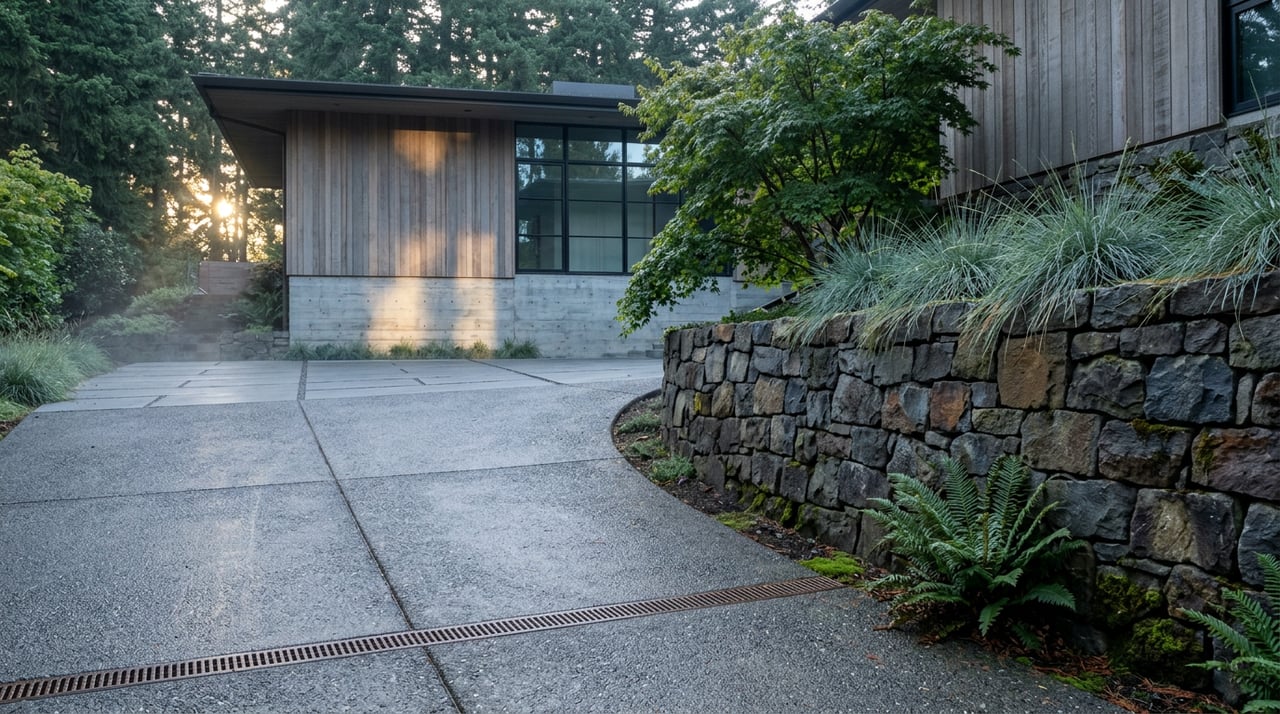
If you're touring a resale on Bull Mountain rather than planning new construction, the existing driveway and any retaining walls on the property are worth a longer look than most buyers give them. A cracked or heaving driveway can be a normal age issue, but on a hillside lot it can also be a sign that the original grading or drainage was done to a lighter standard than the slope required. Local retaining wall contractors report a steady stream of calls to replace failing timber retaining walls, often decades old, with engineered block or natural stone systems built with proper drainage behind them. A failing timber wall holding back a slope above a driveway is not a cosmetic fix. It's a structural one, and it belongs on your inspection radar, not just your landscaping wish list.
Once a new driveway or wall goes in correctly, the first sealcoat at 18 to 24 months is what locks the surface in against the freeze-thaw cycle and the canopy debris that defines the neighborhood. If a seller can't tell you when the driveway was last sealed, ask your inspector to look closely at the surface and the drainage tie-in.
Timing the Work
If your plans include site work this year, weather narrows your window more than it would on a flat lot elsewhere in Tigard. Contractors who specialize in Bull Mountain installs schedule pours between May and mid-September wherever possible, since a proper cure needs four to six consecutive dry days. A contractor promising a hillside pour in late October or November is making a scheduling commitment the weather may not let them keep. If your purchase and any planned addition are tied to a tight timeline, this is one more reason to close with enough runway to hit the dry season, not after it.
Before You Write the Offer
None of this means Bull Mountain is a harder place to build than it's worth. Buyers choose this hill for the views, the tree cover, and the privacy that come with the same terrain that adds cost. But if your plans include an ADU, an addition, a new driveway, or anything beyond cosmetic updates, treat the grade as part of your due diligence, not an afterthought.
Before you write an offer on a Bull Mountain property with future building plans in mind, ask your agent three things: what is the lot's approximate grade, which jurisdiction reviews permits for this specific parcel, and whether the property sits above or below the county's hillside-overlay contour. Those three answers will tell you more about your real project budget than the comps will.
Frequently Asked Questions
Does every home on Bull Mountain require a hillside permit to build an addition? Not every project. The county's hillside-overlay permit and its grading plan, stormwater note, and erosion-control bond apply when a project disturbs more than 500 square feet of ground or sits above the hillside-overlay elevation contour. A smaller, flatter portion of a lot might avoid that threshold entirely, which is why a site-specific check matters more than a neighborhood-wide assumption.
Can I still build an ADU on a steep Bull Mountain lot? Often yes, but the design and budget need to account for the slope from the start. A lot check that reads grade, setbacks, and utilities before drawings are commissioned is the standard first step local builders recommend, since retaining walls and foundation work on a steep pad can add significantly to the city's typical $60,000 to $200,000 ADU cost range.
How much extra should I budget for site work on a Bull Mountain lot compared to a flat lot elsewhere in Tigard? There's no single number that applies to every parcel, since grade varies block to block. As a planning benchmark, grade engineering alone on slopes over 10 percent typically adds 15 to 30 percent to the dirt-work portion of a project, before drainage, tree mitigation, or permitting costs are added in.
If you're weighing a Bull Mountain purchase against other Westside neighborhoods and want a clear-eyed read on what a specific lot will actually let you build, Julie Williams can help you separate the listing price from the real cost of your plans. Schedule a consultation.